One of the things that excited me the most back in the 1990s were videogames, I had a Sega Genesis/Mega Drive console, and I was in Sonic’s side in his market fight with Mario. Back in 1996, I got a new game, Sonic 3D, my 9-year-old mind went crazy with the game: amazing graphics and a new feature: it was 3D. All previous versions of Sonic were 2D, and they had added a new dimension to this new game, now you could move in 3 different directions.
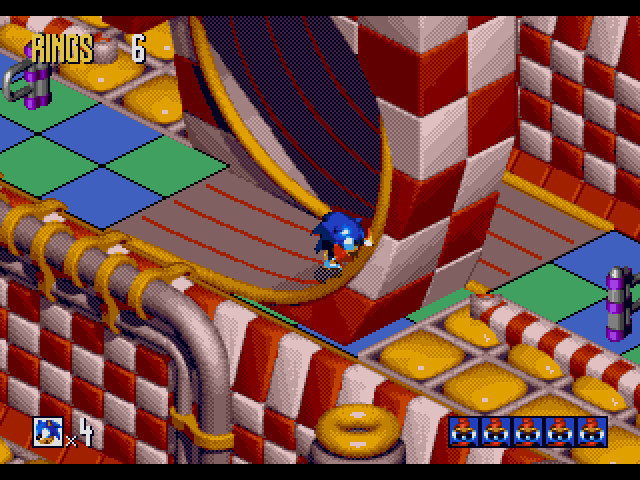
The complexity of the game increased exponentially. Before you only had to worry about going back and forward, jumping and killing enemies. By adding a third dimension, things got harder to find, enemies could evade more easily. There was also the problem of perspective, it was harder to know if something was close or far from you.
Impossible not to relate that topic to the real world. I used to cycle a lot, just after gaming I would cycle and think about coordinates, I was able to move freely in all of them. Uphill, left, right, back. I questioned myself if there was a way of living on a two-dimensional space? The idea of being thin as a cardboard used to make me laugh.
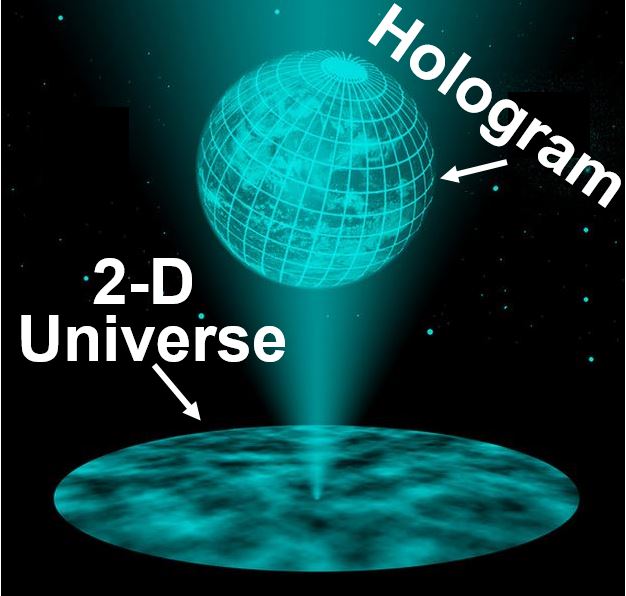
A few year later, I read on a Physics magazine about a theory that our universe could be a projection of a flat structure, imagine a 2D floor, where everything is really real, projecting a 3D world, the one we can see. Similar to the game itself, although I had the impression of playing a 3D environment, the screen of the TV was flat, a projection, a 2D mosaic representing a 3D world. It sounded plausible, but sadly we will probably never be able to find out if the theory is true or not.
If three dimensions were possible, why not 2 or 4 or 30?
After investigating a bit more about the topic, I came across the concept of time as being a fourth dimension. The first thing my young mind questioned was that if we can travel alongside other dimensions, why not travel in time too? Although exciting, it’s clear that time travelling is likely to be impossible, at least to the past.
When we think about how we can move through the Universe, we immediately think of three different directions. Left, right, forward, backward, upward or downward: the Cartesian grid. All three of those count as dimensions, and specifically, as spatial dimensions. But we commonly talk about a fourth dimension of a very different type: time. But what makes time a dimension at all?
Here on the surface of the Earth, we normally only need two coordinates to pinpoint our location: latitude and longitude, or where you are along the north-south and east-west axes of Earth. If you’re willing to go underground or above the Earth’s surface, you need a third coordinate to describe your location. After all, someone at your exact two-dimensional, latitude-and-longitude location but in a tunnel under you or in a helicopter above isn’t truly at the same location as you. It takes three independent pieces of information to describe your location in space.
But spacetime is even more complicated than space, and it’s easy to see why. The chair you’re sitting in right now can have its location described by those three coordinates: x, y and z. But it’s also occupied by you right now, as opposed to an hour ago, yesterday or ten years from now. In order to describe an event, knowing where it occurs isn’t enough; you also need to know when, which means you need to know the time coordinate.
If you want to move through space requires movement through time, so if you’re here now, you cannot be somewhere else now as well, you can only get there later. In 1905, Einstein’s special relativity taught us that the speed of light is a universal speed limit, and that as you approach it you experience the strange phenomena of time dilation. But in 1907, when Minkowski realized that Einstein’s relativity had an extraordinary implication: mathematically, time behaves exactly the same as space does.
Putting all of these revelations together gave us a new picture of the Universe, if you’re completely stationary, remaining in the same spatial location, you move through time at its maximum rate. The faster you move through space, the slower you move through time. The remarkable thing is that anyone, regardless of their motion through space relative to anyone else, will see these same rules, these same effects and these same consequences. If time weren’t a dimension in this exact way, the laws of relativity would be invalid. We need the dimensionality of time for physics to work the way it does, and yet our Universe provides for it very very well.
Who and how the universe will decide if you will be sitting on the same chair you are right now in 10 years? You can say you have free choice, but the very same brain that will decide if you will sit or not in the chair is also part of the same 4D universe.
What if there’s a very long formula describing everything that will happen to the universe, since its creation (either by a superior entity, or a Big Bang, for example) until its end (when the same superior entity decides to end it, or a Big Crunch)? If there’s a big formula that describes the behaviour of our universe, then it should be able to describe both the past and also the future! Everything that ever happened since its beginning, as well as everything that will happen. Every decision you will make has already been defined by this very same formula. If you will or not be sitting in this chair in 10 years is already decided, there’s nothing you can do about it.
Is this not the same of time travelling? A big formula describing the universe and everything that happens to it is the key to time travelling. Once you understand and can play with the formula you can know everything that happened in the past, Big Bang, how our galaxy was formed, how life started on Earth, as well as the future, when we will make contact with aliens, when our species will reach another solar systems, when our galaxy will merge with Andromeda, when our universe will die out.
We already do that all the time, we predict things by using mathematical projections (formulas), we know it will probably rain in 10 days, we know that the Earth will heat up in 50 years, we know that a comet will pass by us in 100 years.
Everything happens for a reason, and that’s because everything that will ever happen, has already been decided, as in Ecclesiastes 6:10-12:
Everything has already been decided. It was known long ago what each person would be. So there’s no use arguing with God about your destiny. The more words you speak, the less they mean. So what good are they? In the few days of our meaningless lives, who knows how our days can best be spent? Our lives are like a shadow. Who can tell what will happen on this earth after we are gone?
Thyago S Falconi
This text has been has been inpired by the brilliant work done by Ethan Siegel.
 thyago falconi